 SEOSEO Reporting and Rank Tracking: What UK Businesses Should MeasureWhat a useful SEO report includes, which metrics matter, how to use keyword rank checkers sensibly, and how AI search changes reporting.
SEO Audit: What It Checks and How to Run One
What an SEO audit checks, how to run a basic website audit with free tools, and when SEO audit services are worth it for UK businesses.

An SEO audit is a structured check of your website that finds what stops search engines from crawling, understanding and ranking your pages, then lists the fixes in order of impact. A good SEO audit covers technical health, content, links and how you compare with competitors, and it ends with a clear action plan rather than a long list of warnings. For most UK businesses, it is the right first step before spending more on content or search engine optimisation.
This guide explains what a website audit checks, how to run a basic one yourself with free tools, and when it is worth paying for SEO audit services. It is written for business owners and marketing managers in London, Manchester, Birmingham and across the UK.
What an SEO audit checks
A thorough SEO audit looks at four areas. Each answers a different question about your site.
| Area | The question it answers | Typical checks |
|---|---|---|
| Technical SEO | Can search engines find and read every important page? | Indexing, crawl errors, redirects, site speed, mobile usability, HTTPS, structured data |
| On page SEO | Does each page clearly answer one search? | Page titles, meta descriptions, headings, duplicate or thin pages, internal links |
| Content | Is the content helpful, accurate and current? | Outdated pages, gaps against customer questions, pages competing for the same keyword |
| Off page | Do other sites trust you? | Referring domains, harmful links, brand mentions, reviews |
Local businesses should add a fifth area: Google Business Profile, reviews and consistent listings. Our local SEO work covers that part.
Technical SEO audit: the foundation
Technical problems block everything else, so a technical SEO audit comes first. These are the checks that matter most.
Indexing
Open the Pages report in Google Search Console. It shows which pages Google has indexed and why others were left out. Look for important pages marked as excluded, blocked by robots.txt, or marked noindex by mistake.
Speed and Core Web Vitals
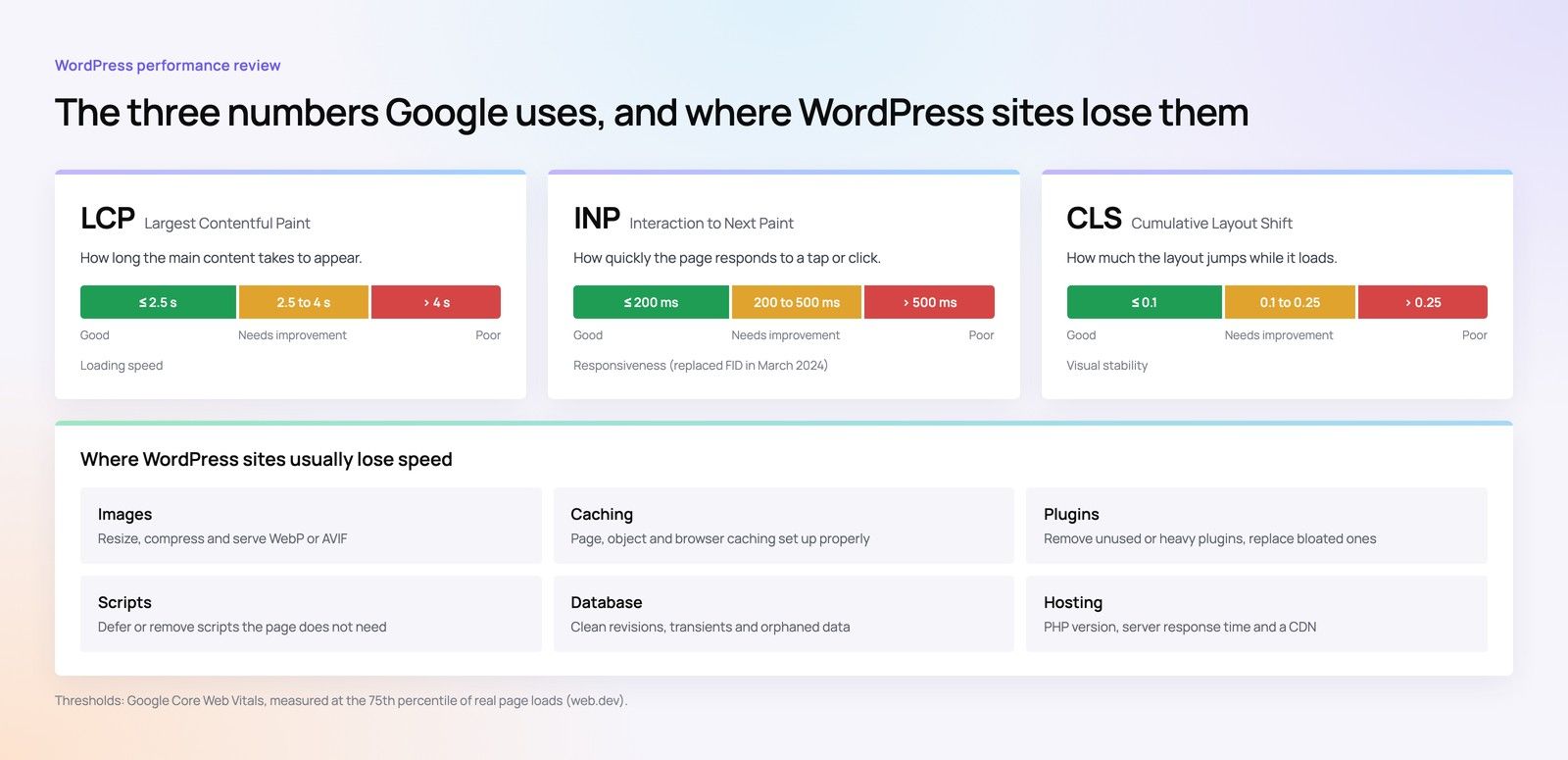
Google measures real visitor experience through Core Web Vitals: how quickly the main content loads, how fast the page responds to a tap, and how much the layout shifts. Slow templates, heavy images and too many scripts are the usual causes. Our Core Web Vitals work and speed optimisation quick start target exactly these.
Site structure and redirects
Every important page should be reachable within a few clicks from the home page, with clear internal links. Old URLs should redirect once, straight to the right new page, not through chains. If you have changed platform or domain in the past, check that the old URLs still redirect properly. A planned site migration avoids most of these problems in the first place.
Mobile and structured data
Check every key template on a real phone, not only in a desktop browser. Then check structured data, such as Organisation, LocalBusiness, Product or Article markup, for errors in Google's Rich Results Test.
On page and content audit
Once the technical base is sound, look at what each page says.
- One search per page. List your important pages next to the main search each one targets. If two pages target the same thing, merge them or change one.
- Titles and meta descriptions. Each page needs a unique, specific title and a description that gives a reason to click.
- Headings. One clear main heading, with subheadings that follow a logical order.
- Thin and outdated content. Update pages with old facts, merge short pages that say little, and remove pages nobody needs.
- Helpfulness. Google's guidance on creating helpful, reliable content is a useful checklist for experience, expertise and trust, often shortened to E E A T.
How to run a basic SEO audit yourself
You can cover a lot with free tools and an afternoon.
- Search Console. Check the Pages report for indexing problems and the Performance report for the searches that bring visitors.
- PageSpeed Insights. Test your home page, a key service page and a blog post on mobile.
- A crawler. Free versions of desktop crawlers will list broken links, redirect chains, missing titles and duplicate pages on smaller sites.
- A manual review. Search for your main services and compare your pages with the ones that rank above you. Note what they answer that you do not.
- A priority list. Sort fixes by impact and effort. Fix what blocks indexing first, then speed, then content.
A free SEO checker or website SEO checker gives a quick score, but treat it as a starting point. Automated tools flag many minor issues and miss the bigger questions, such as whether your pages answer what customers actually search.
When to use SEO audit services
A professional SEO audit service is worth it when:
- Your traffic has dropped and you do not know why.
- You are planning a redesign, a new platform or a domain change.
- Your site is large, such as an online shop with thousands of products.
- Your site is built on a JavaScript framework and pages may not render for search engines.
- You need a prioritised plan your developers can act on, not a generic report.
When comparing providers, ask to see a sample audit. A useful one explains each issue in plain English, shows the affected pages, estimates the impact, and says who should fix it. Be cautious of audits that are mostly automated screenshots with a score.
What to do after the audit
An audit only helps if the fixes happen. Agree an owner for each item, schedule the technical fixes with your developers, and plan content updates over the following months. Recheck Search Console monthly and run a lighter audit every six to twelve months, or before any major site change.
Codeeo has delivered over 200 projects across the UAE and the US, with a team of more than 80 people in Dubai, Riyadh and Karachi. Because our SEO and digital marketing team works alongside our web developers, the fixes from an audit do not wait at another supplier. Our technical SEO review and website audit are fixed scope ways to start, or you can contact our team.
Frequently asked questions
An SEO audit is a review of your website that finds the problems holding back its search visibility.
It checks technical health such as indexing, speed and redirects, on page elements such as titles and headings, content quality, and links from other sites. A good audit ends with a prioritised action plan, so you know which fixes will make the biggest difference and who should carry them out.
Most businesses benefit from a full SEO audit once a year, with lighter monthly checks in Google Search Console.
Run an extra audit before a redesign, platform change or domain move, and whenever traffic drops suddenly. Large sites, such as online shops that add and remove products often, may need technical checks every quarter to catch indexing and redirect problems early.
A free SEO checker is a useful starting point.
It quickly flags missing titles, broken links and slow pages. But automated tools cannot judge whether your content answers what customers search for, how you compare with competitors, or which fixes matter most. Use free tools for regular checks, and a human led audit when you need a clear plan.
A technical SEO audit checks whether search engines can crawl, render and index your site, covering speed, redirects, site structure, mobile usability and structured data.
A content audit checks what your pages say: whether each one is accurate, useful, current and focused on one search. Most sites need both, with technical fixes first because they affect every page.
A basic audit of a small business website can be done in a day or two.
A full audit of a large site, such as an online shop with thousands of products or a site with several languages, takes longer because there is more to crawl and analyse. The useful output is the prioritised plan, so allow time to review it with your team.
SEOSEO Reporting and Rank Tracking: What UK Businesses Should MeasureWhat a useful SEO report includes, which metrics matter, how to use keyword rank checkers sensibly, and how AI search changes reporting. SEOOff-Page SEO: Backlinks and E-E-A-T for UK BusinessesWhat backlinks are, how E-E-A-T works, safe ways to earn links in the UK, and how off-page SEO supports visibility in AI search.
 SEOOn-Page SEO in 2026: A Practical Checklist for UK WebsitesA practical on-page SEO checklist: titles, meta descriptions, headings, content, SERP features and how to check every page on your site.
Tell us what the business needs. We will tell you what to build first.
Schedule a free consultation and get a written recommendation, with costs, before you commit to anything.
Get in touchPROVEN RESULTS
4.7 / 5verified reviews on Google