 SEOSEO Reporting and Rank Tracking: What UK Businesses Should MeasureWhat a useful SEO report includes, which metrics matter, how to use keyword rank checkers sensibly, and how AI search changes reporting.
International SEO: A Guide for UK Businesses Going Global
How international SEO works: choosing subfolders or country domains, using hreflang correctly, and creating content for each market abroad.

International SEO is the work of making your website visible in search results in other countries and languages, so customers abroad find the right version of your site in their own language. It covers how you structure the site for each market, how you tell Google which page is for which audience, and how you research and write content for each country. For UK businesses expanding into Europe, the Middle East or North America, getting this right early avoids duplicate content problems and wasted translation budgets.
This guide explains how international SEO services work, the structural choices you need to make, and when enterprise SEO or an international SEO consultant makes sense.
What international SEO involves
International SEO answers four questions:
- Which markets? The countries and languages worth targeting, based on real demand and your ability to serve them.
- Which structure? How each market's pages are organised on your domain or domains.
- How will Google know? The signals that tell search engines which page serves which language and region.
- What content? Pages researched and written for each market, not only translated.
Choosing a site structure for international SEO
Google explains the main options in its guidance on managing multi regional and multilingual sites.
| Structure | Example | Strengths | Trade offs |
|---|---|---|---|
| Country domains | example.de, example.fr | Clear country signal, local trust | Each domain builds authority separately, higher running effort |
| Subfolders | example.com/de/ | Shares the main domain's authority, simpler to run | Weaker local signal than a country domain |
| Subdomains | de.example.com | Can be hosted separately | Often treated more like separate sites |
For most UK businesses entering a few markets, subfolders on one main domain are the simplest and strongest starting point. Country domains suit businesses with large local operations in each market.
Hreflang: telling Google which page is for whom
Hreflang annotations tell Google that several pages are versions of the same content for different languages or regions, so the right one appears in each market. Google documents the rules in telling Google about localised versions of your page.
The common mistakes are easy to avoid once you know them:
- Missing return links. Each version must list all the others, including itself.
- Wrong codes. Use ISO language codes, with optional region codes, such as en-gb, en-us or ar-ae.
- Pointing to redirected or blocked pages. Every URL in hreflang should load directly and be indexable.
- Conflicting canonicals. Each language version should point its canonical tag to itself, not to the English page.
- No fallback. An x-default version helps visitors whose language you do not serve.
Avoid redirecting visitors automatically based on location alone. Let people and search engines reach every version, and offer a clear language switcher.
Keyword research and content for each market
Translation alone rarely works. People in different countries use different words, search for different things and expect different proof. For each market:
- Research keywords in the local language with local tools and native speakers.
- Check what ranks locally, which often includes different competitors from the UK.
- Adapt examples, currencies, measurements, regulations and contact details.
- Build local trust with reviews, case studies and links from sites in that country.
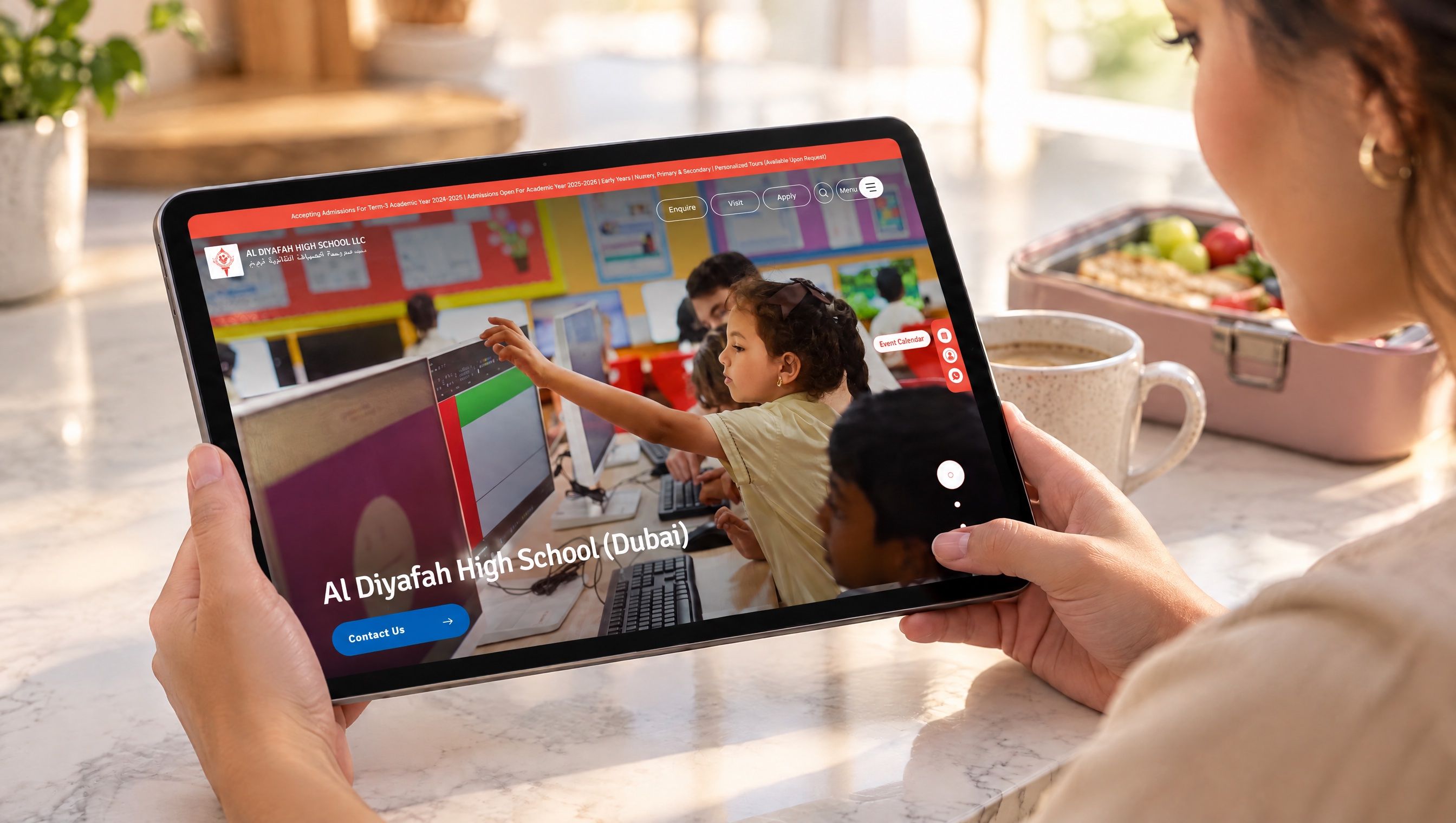
Our Diyafah case study shows a bilingual school website with a right to left Arabic edition, a good example of a second language built properly rather than bolted on.
Technical checks for international websites
- Each market version is indexable and listed in your XML sitemap.
- Pages load quickly for visitors in each country, often with a content delivery network. Our Core Web Vitals work covers this.
- Structured data uses the correct language, currency and address for each market.
- Search Console tracks performance by country so you can see each market separately.
Enterprise SEO: international SEO at scale
Enterprise SEO applies the same principles to large sites with thousands of pages, many markets and several teams. The challenges shift from individual fixes to systems: templates that work in every language, publishing workflows with approval steps, governance so local teams do not break global rules, and reporting across markets. Enterprise SEO services usually combine technical audits, platform changes and training for in house teams.
If a new market also means a new platform or domain, plan the move as a site migration so existing UK rankings are protected.
When to hire an international SEO consultant or agency
An international SEO consultant or agency helps when:
- You are launching in a new country and need to choose the right structure first.
- Your foreign language pages get little traffic despite being translated.
- Search Console shows the wrong language version ranking in a market.
- You run many markets and need a technical audit across all of them.
How Codeeo helps with international SEO
Codeeo has delivered over 200 projects across the UAE and the US, with a team of more than 80 people in Dubai, Riyadh and Karachi. We build and optimise multilingual sites, including English and Arabic, with our web development and SEO teams working together. A technical SEO review is a good first step, or you can contact our team.
Frequently asked questions
International SEO is the process of optimising a website so it ranks in several countries or languages.
It covers choosing a site structure such as subfolders or country domains, using hreflang to tell Google which page serves which audience, researching keywords in each language, and creating content adapted to each market. Done well, the right local version appears for searchers in each country.
For most businesses entering a few new markets, subfolders on one main domain, such as example.com/de/, are simpler to manage and share the main site's authority.
Country domains, such as example.de, send a stronger local signal and suit businesses with large operations in each country, but each one needs to build authority separately and costs more effort to run.
Hreflang is an annotation that tells Google that several pages are versions of the same content for different languages or regions.
It helps Google show the right version to each searcher, for example the British English page in the UK and the Arabic page in the UAE. Each version must reference all the others, use correct language codes and point to indexable pages.
Usually not.
People in different countries use different search terms, expect different examples and trust different signals. Research keywords in each language, adapt currencies, regulations and contact details, and build local reviews and links. Machine translation without review often reads poorly and converts badly. Treat each market as its own audience rather than a copy of your UK site.
Enterprise SEO is SEO for large organisations with very big websites, many markets or several teams publishing content.
It focuses on systems rather than single fixes: scalable templates, technical health across thousands of pages, publishing workflows, governance and reporting across markets. Enterprise SEO services usually combine audits, platform changes and training for in house teams.
SEOSEO Reporting and Rank Tracking: What UK Businesses Should MeasureWhat a useful SEO report includes, which metrics matter, how to use keyword rank checkers sensibly, and how AI search changes reporting. SEOOff-Page SEO: Backlinks and E-E-A-T for UK BusinessesWhat backlinks are, how E-E-A-T works, safe ways to earn links in the UK, and how off-page SEO supports visibility in AI search.
 SEOOn-Page SEO in 2026: A Practical Checklist for UK WebsitesA practical on-page SEO checklist: titles, meta descriptions, headings, content, SERP features and how to check every page on your site.
Tell us what the business needs. We will tell you what to build first.
Schedule a free consultation and get a written recommendation, with costs, before you commit to anything.
Get in touchPROVEN RESULTS
4.7 / 5verified reviews on Google